
“Fortunately, I am Nunk. I have the wisdom and the knowledge of the ages.” — Nunk
“Prophet Motive” Part 1
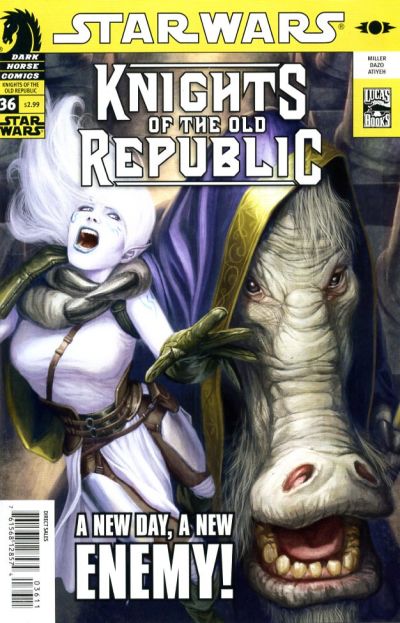
A new era of adventure begins!
Art by Bong Dazo
Lettered by Michael Heisler
Colored by Michael Atiyeh
Cover by Dan Scott
Edited by Dave Marshall and Freddye Lins
 Coming out of “Vindication,” the aim with “Prophet Motive” was to launch the series immediately into its new direction. There was easily a whole issue — or two — that could have been done on Coruscant involving the events after “Vindication” — but that would have been looking backward, not forward. And the thinking that we went into “Vector” with in #25 was still sound: Start a little later, after the pieces have moved on the board again — and we’ll catch up with them in the middle of the action. This time, however, instead of having the rest of the cast off-panel, it was Zayne that was absent. What he did on his “summer vacation” is one of several mysteries the series carries forward into Year Four. Every character in the cast has secrets they’re not sharing; it was only fair that he get a few!
Another major mission was to bring readers to places they hadn’t seen before in the Star Wars universe. I’d liked creating places like Flashpoint and Telerath and their associated situations; for 2009, we’d be doing a lot of that. This story’s mash-up of astronomy and high finance is the first of several such scenarios, and it appealed to several of my interests. I spend an inordinate amount of time watching CNBC, and not just to see Erin Burnett make me feel better about my stock portfolio. It’s dazzling trying to comprehend all the things people have figured out how to buy, sell, and trade. It struck me that in the go-go-go economy of the Old Republic period that we’d set up, there would be even crazier financial markets where everything would have a price — and everything would be a product. I actually worked up the storyline well before the credit crisis of late 2008, but its release was certainly timely. If you think that there are similarities between the promises bought and sold on Metellos 3 and credit default swaps and other arcane earthly financial instruments, that’s less than accidental.
One change I made with this issue was on the storytelling side: For the first time in any of my original comics work, I brought in an omniscient narrator. In the past, I’d been less willing to do so: an omniscient narrator is the voice of truth, and in a series where misdirection is a theme, that can be a hazard. The narrator needs to be an honest broker. I also am not very big on telling readers what they should be thinking about what they’re seeing — which happens a good deal in a lot of comics of the old school. (“Suddenly, the most amazing thing in the universe happened!”) I’d used a narrator in the Indiana Jones and the Kingdom of the Crystal Skull adaptation, to help deal with transitions in some of the omitted scenes and with some of the tougher-to-depict action bits, but I didn’t want something similar in KOTOR.
But when I thought of the many new locations the series would be visiting in its fourth year, I found a limited role for an omniscient narrator I was comfortable with: tour guide. In the past, I’d introduced new places like Telerath with a literal tour guide — a character who provide information to supplement the artist’s depiction. But there was already a literal tour guide in “Prophet Motive” in Cipiter — and he already had plenty of lines in that regard, and he dissembles about a number of things. But the history of Metellos 3 was entirely true, so there was no problem shifting that into an introductory narration.
The narration continues in later issues in this sequence in an identical manner — low-impact, introductory scene-setting. It is a departure from past issues, and I briefly considered giving it some kind of “Hitchhiker’s Holofeed” framing so the narrator was a source — but that read as affected, and, after all, we’d already had “non-fiction” content coming into the series from the Campaign Guide and the Handbook. So we played it straight — and it became one more defining difference between the first and second eras of the series.
Finally, the issue’s combat depicts Bong Dazo’s clever solution to a scene that’s otherwise not always very easy to depict in comics I’d imagined a bit where Rohlan and Jarael begin the combat with weapons more suited for each other — and figured that they’d do a mid-air weapons exchange, with her tossing him his pistols in exchange for the energy batons he’s carrying. At the same time, we’d work in a little acrobatics for her — especially useful since Rohlan’s got to have a line of fire once he gets the weapons. Bong came up with a sequence with five Rohlans and six Jaraels — by which they made the swap and traded positions, all in one page. Any live-action version will doubtless involve slow-motion animation of some sort!
“Looks like vacation’s over!” — Zayne Carrick


The first question readers of the preview of this issue had — and I’m not surprised why — is whether the planet being hustled at the opening is Bespin. The truth is: It was, before it wasn’t — and it was a lucky coincidence that I caught it. To wit: When I started, there’d been no Old Republic history on Bespin that I could find — and so a gentle Original Trilogy nudge fit in nicely. Film-viewers remembering the Anoat Sector and the floating city would get the reference. But then I got my advance copy of the Star Wars: Knights of the Old Republic Campaign Guide to the Star Wars Role-Playing Game. While I’d seen some of the sections done by my fellow authors, I’d never seen Rodney Thompson’s section on locations — where he’d established that Bespin was, indeed, known and explored by this time. So I suggested a re-coloring of the planet on page one, as well as a new diameter establishing for the few readers who would look it up that while the planet looks like Bespin, it is in fact just one of several planets with similar composition in that sector. This way, we got the best of both worlds (no pun intended) — a film reference that didn’t change the history of anything!
Bong Dazo includes more aliens on the second splash than I’ve seen in an issue of the series. His novel “camera angles,” something I first noticed back in his work on #19, play really well in the walkthrough of this issue.
Bong’s Beast-like Gryph goes even more Hank McCoy when delivering all the potted aphorisms he has to as the Professor!
We may have, in Hot Prospect, the toughest model to kit-bash ever done for the series. It’s exactly as I’d described — a chaotic, complicated flying industrial site. Calipsa I brought in from the old West End Player’s Guide to Tapani.
This is the first time we included Rohlan in one of our masquerades — and it occurred to me that it wouldn’t be too difficult to pull off. Bong makes him very un-Mandalorian with just a few choice accoutrements.
Read “Cap’n Brackel’s” dialogue carefully — and you may see her inspiration. She’s speaking her lines exactly as Camper would have!
“No-Neck” Plaarvin we first mentioned back in the Handbook, in Gryph’s entry. The anatomical issue of Chevin and their necks comes up later in the storyline.
Nunk uses a line that’s been rattling around my head for decades. Back in my first newswriting class at the University of Tennessee — the class, incidentally, where I met John Hudgens, director of Sith Apprentice and many other fanfilms — Dr. George Everett assigned the class to write a lead about, of all things, a piece of chalk. In giving examples of how not to start a news story, the Doc suggested: “I am Chalk. I speak for the knowledge and the wisdom of the ages!” Nunk Plaarvin is both a legend in his own mind and, coincidentally, as smart as a piece of chalk, so the line was naturally a good fit for him!
I wondered how a Chevin would speak into a comlink when his ears are half a parsec away from his mouth; Nunk provides one suggestion, here. (And, yeah, I had just listened to Bob Newhart’s “Button-Down Mind” album for the umpteenth time when thinking up the comlink conversation scene.)
Note that Rohlan’s real helmet was carried to Metellos 3 by Gryph — in the bag he’s seen with right from the start!
Zayne Carrick appears in fewer pages of this issue than any to date, tying only #18. Though I suppose he doesn’t really appear in #16, when you think about it.
Zayne’s new attire first appeared in public with the solicitation for the cover of #37 — where it was immediately asked whether the lightsaber color was a mistake. No, it’s not — although the story behind it will take somewhat longer to unfold. Zayne’s original lightsaber, which stayed with him throughout the first three years of the series, was lost in #35.

Latest edition

Star Wars: Legends Epic Collection – The Old Republic Vol. 2
After Zayne Carrick is framed for the murder of his fellow Jedi in training, his poor luck prevents him from clearing his name and throws him into dangerous situations all over the galaxy, leading to his final confrontation with the Jedi Masters who massacred their own Padawans!
More info →



Earlier editions

Star Wars Omnibus: Knights of the Old Republic Vol. 2
After Zayne Carrick is framed for the murder of his fellow Jedi in training, his poor luck prevents him from clearing his name and throws him into dangerous situations all over the galaxy, leading to his final confrontation with the Jedi Masters who massacred their own Padawans!
More info →
Star Wars: Knights of the Old Republic Vol. 7: Dueling Ambitions
Former Padawan - and former fugitive - Zayne Carrick is taking his life in a new direction. Along with his con-artist best friend Gryph; the beautiful, bold, and mysterious Jarael; and ex-Mandalorian warrior Rohlan; our bumbling yet lovable hero is ready to embark on the sort of adventures only possible in the Star Wars universe! In "Prophet Motive," it's a long-shot swindle gone wrong; in "Faithful Execution," it's a ghost ship and renegade droids; and in "Dueling Ambitions," it's combat sports and high-speed racing.
More info → |
 |
 |