
“I don’t know your name — but I take up your cause. I will not remove this mask until there is justice — until the Mandalorians have been defeated once and for all!” — Revan
“Masks”

A special one-shot story featuring Malak and Revan from the Knights of the Old Republic video games sets our main cast on a deadly new course!
Art by Ron Chan
Lettered by Michael Heisler
Colored by Michael Atiyeh
Cover by Benjamin Carré
Edited by Dave Marshall and Freddye Lins
 Before KOTOR #1 came out, I was advised by a veteran franchise writer that practically anything you do impacts someone’s fan-fiction, someone’s existing view of characters and situations. If you intend to mention existing characters at all, there’s no way around it. That’s just writing within a franchise — a house to be lived in isn’t a museum. And in a room that’s going to see a lot of use, like the time of the Mandalorian Wars, you’re likely to touch a lot of the furniture — or spend an inordinate amount of time tiptoeing.
The Wars, however, had something special: Revan. Among all characters, Revan is one of those to whom people feel a particularly personal attachment — for reasons that should be obvious to players of the game, but which I will not reveal for those who have not played. Much of Revan’s history, appearance — even, for a long time, gender — were left open to individual interpretation, as a result. More was known of Malak — he being a non-player character — but there were still a large number of blanks.
Including, from the start, even their real names. While Revan and Malak had been assumed by gamers to be those characters’ birth names, it was clear from discussions before the series began that it was an assumption. We knew from game dialogue what the names of the characters were during the games — and people referred to those character’ earlier lives by the names they knew. But we never got the equivalent of a high school yearbook for confirmation. Further, and critically from my point of view, it was always an open question why anyone adopting the Sith tradition of Darth-naming would disregard a major part of it — the muscular suffix, the evil nom de guerre. Malak, for one, sure sounded like that kind of a handle. You could imagine being named Malak — some real people are, and probably very nice — but you could also imagine naming yourself that, to make an impression.
The question at the beginning of the KOTOR comics series, though, was how many blanks like that we intended to address — if any. It was an important question. We didn’t want to confuse readers about the real stars of the series; we’d already settled on an independent direction with Zayne and the Covenant. Taking in only #1-6 (ignoring Squint’s cameo in #6), there’s no direct mention of the crusaders organizing in this period at all. We also didn’t want to bring in Revan and company just as a stunt — if they appeared, it should be for something important. Brief, but important. They’re not furnishings, then, but live actors in the room that can influence things on their own.
It was after “Commencement” had been plotted and we looked down the road to other stories that their place became clear. The Covenant needed a countervailing force to agitate against, beyond simply the Jedi Council’s practiced neutrality. Revan’s force was the natural choice — also trying to tug the Jedi Council into action, but in a different direction.
Thus Malak and Revan made their first appearances in KOTOR #0 — their stories then advancing not so much in parallel to Zayne’s, but more in the nature of a helix, intersecting at important points. Revan returned in #9, which showed the two groups’ conflicts with the Council in detail. In between, Malak’s party — including Ferroh, the Cathar character named in #42 for the first time — encountered Zayne again on Flashpoint. Revan’s next appearance was in the cutaway shot in #15, in the same location that the flashback this issue finds him. In between, we saw more of Malak — his growing relationship with Jarael, and his increasing disaffection with his treatment.
That the Revanchist was Revan and that Alek was Malak were things that game-playing readers were supposed to know — or figure out before too long — but that the characters weren’t aware of. By late 2007, guidebooks were providing the confirmation. The moment of confirmation in the comics, meanwhile, ended up happening in stages — part before “Vindication,” part here.
I’d always intended for the Cathar massacre — described in another guidebook as the event that won Revan popular support — to be that moment. Juhani, a game character, had been described as a child at the time of the massacre — which mean that this motivating factor had to lie somehow years in the past, but also have impact in the present. I came up with the solution that appears here fairly early in the series, but it couldn’t appear until around now, about the time that something happens to change Jedi officialdom’s posture (since we see Revan’s Jedi working openly with the Republic in later accounts).
So, yes, “Masks” worked to address a continuity issue by making all accounts correct — wonderful when you can work it — but as before, the important thing was that it added something to the ongoing storyline. The difference between readers seeing this explanation — or just learning it through dialogue or a resource book somewhere — was whether the moment, dramatic on its own, was also pivotal to what was going on with Zayne, Jarael, and company. As seen here, the timing is very apt — and perhaps touches less of what was left to the imagination than first appears. Revan’s face is not shown — and ultimately, the question of Revan’s name before Cathar is one on which this issue takes no position (though inferences are possible, nothing is in black and white). Malak is another matter. He was born simply Alek; his sesquipedalian surname and nickname came later, and are by his words here disavowed.
This issue also included a nifty addition that probably shouldn’t be classified as trivia, since it’s not trivial: Earlier, Pete Hottelet had won the Penny Arcade charity auction with a generous gift that earned him an appearance in a Star Wars comic book. There have been a few similar things in comics — and I remember a Midsouthcon auction where author David Weber sold, first, a walk-on role in a Honor Harrington novel — and then, immediately afterward, the right to decide whether that character lived or died! This had never been done in Star Wars before, to my knowledge, and I was happy to participate. Hottelet became Captain Telettoh, Malak’s liaison to the Republic Navy — I’d considered doing something anagramming the name, but figured a simple backwards-spelling would make it an easy conversation piece in thanks for his contribution to a good cause.
“I’ll never understand why people fight when there’s no money involved.” — Gryph


This issue featured Ron Chan‘s first (and, as it turned out, only) work on Knights, and another awesome cover by Benjamin Carre. Ron came up with a much better idea for the ending than I had — with Malak rising and looking down, rather than standing on the ground, watching Zayne leave. Works much better, this way!
I actually forgot that I helped invent tandreeds. I dug around for awhile to find an alien equivalent to a horse that I liked — Shiva steeds were interesting but too large. This Wor Tandell cousin fit the bill.
Wor Tandell existed previously — I’d found it in a West End guide for The Empire Strikes Back. It had never appeared physically, though, after seeing planets that were vaguely reminiscent of various Earthly settings, I wanted this setting — with this issue’s patriotic story elements — to have a vaguely colonial or antebellum American look to it. It’s not a sort of setting we’re used to seeing, and Ron Chan does a great job with it here.
Yes, Slyssk has friends. Hard to believe, isn’t it?
That’s the Goethar Special Zayne’s riding — it’s picked up a few bugs on the hood!
“Testament” is also the name of an exceptionally scary nuclear-war film from the 1980s. No irony there…
The date Ferroh gives for his return to Cathar is actually two years after the date that appeared for the massacre in the KOTOR Campaign Guide. I didn’t write the timeline section of the guide, but I may well have contributed a date from an earlier draft and changed it later. The more specific date is probably the correct one.
Another small error, also mine, appears with Malak’s tattoo, which vanishes in the flashback. I flat forgot the flashback followed #31, and mentioned it as missing; we caught it on the first page, at least.
“Ke’serim” is Mando’a for “Take aim” — or at least it was in the original Hyperspace dictionary file.
Yep, that’s a purple lightsaber. Stolen from Samuel Jackson‘s trailer.
Zayne’s third series kiss is, again, not the least bit about what it’s about. Can’t catch a break, that one.
While I expect the issue had that and a couple of other panels people were waiting for, one of my favorites in a while is Gryph helping Rohlan hobble home. I doubt anyone else can call Rohlan “granny…”

Latest Edition

Star Wars: Legends Epic Collection – The Old Republic Vol. 3
Zayne Carrick's adventures continue in the finale to the Knights of the Old Republic comics series! Contains issues #37-50 of the Knights of the Old Republic comics series and issues #1-5 of the Knights of the old Republic: War series.
More info →



Earlier editions

Star Wars Omnibus: Knights of the Old Republic Vol. 3
Free at last from the false charges against him, former Padawan Zayne Carrick is ready and able to search out adventure with his group of companions, but when he discovers that one of his allies, the beautiful Jarael, has been running from her past, he dedicates himself to her redemption. Soon, Zayne is caught in a web of sport dueling, slavery, an evil twin, an ancient society, and finally, the frontline of the Mandalorian Wars!
More info →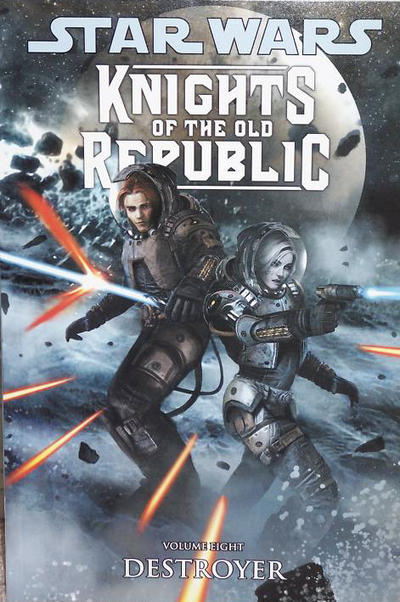
Star Wars: Knights of the Old Republic Vol. 8: Destroyer
Knights of the Old Republic: Destroyer begins with an untold chapter from the lives of Malak and Revan - stars of the Knights of the Old Republic video game! From there, it takes us to a death-defying shootout on the face of a comet and into the heart of one of the cruelest organizations in the galaxy - the Crucible. Former Padawan Zayne Carrick risks not just his life, but also his sanity, to help his friend Jarael face her dark past. Zayne may have set off for adventure, but what he finds are irreversible consequences for himself and his crew in a dangerous, unforgiving galaxy.
More info → |
 |
 |