
“He had to go with her — and that meant he had to be me.” — Rohlan Dyre
“Demon” Part 2

The origin of Demagol at last!
Art by Brian Ching
Lettered by Michael Heisler
Colored by Michael Atiyeh
Cover by Benjamin Carré
Edited by Dave Marshall and Freddye Lins
 Rohlan Dyre was the most conventional hero in the Knights of the Old Republic comics series. Perhaps that’s why we stuck him in a coma for most of it. This was not a series for conventional heroes!
But Demagol’s masquerade, a major feature of the series viewed in retrospect, actually began as an afterthought. In the summer of 2005, I had just completed the pitch to “Flashpoint,” concluding with the moment Rohlan snuck aboard the Last Resort. At the time, my plan was for Rohlan to emerge in “Days of Fear” as we saw, joining the regular cast; Demagol would initiate his pursuit of Jarael from custody. “There’s a stowaway who can hold out indefinitely in that container,” I wrote, “coming out when we least expect him.”
Then I looked back at the rest of the story — and wrote another line. “He might be Rohlan; he might be Demagol. Heh, heh, heh…”
It just fit. “Flashpoint” began with a masquerade; it culminated with one. Why not launch another one in the epilogue — one that made the story more important down the line? It really put a “live by the scam, die by the scam” spin on Zayne and Gryph’s activities — and allowed the Jarael origin subplot to advance without it needing to be the main storyline. And the whole point of Rohlan’s run was that some Mandalorians were doing not-very-Mandalorian things. He himself participates in a ruse in “Flashpoint”; he might even have considered a little karmic payback inevitable. (Maybe not winding up in a coma for months, but c’est la guerre.) So poor Rohlan was slipped a mickey for the duration. But don’t worry — he’s getting his chance to balance the scales!
A good deal about how we handled the masquerade behind the scenes was covered in an essay in this issue’s letter column. Figuring that not everyone reads creator’s blogs, online interviews, and internet forums, we thought it would be nice to say something about Demagol’s charade and how it had all come to gether to readers who had been following the tale from the beginning. I’m appreciative that Dark Horse helped make it happen for this “now it can be told” issue.
While this was an issue that had a lot to convey about the past — like #10 and #33 had — showing it all in live flashbacks, as we had in those issues, was never considered. Room was a concern — as was keeping the narrative’s impact focused on the present. Experiencing firsthand what happened in the past wasn’t as important as dealing with history’s effects on the present.
Rohlan had already narrated a history for us in #8, so naturally, the task fell to him. One early idea, intercutting Rohlan’s history of Demagol as related to the heroes with Demagol’s personal history as related to Jarael, was interesting but ultimately inappropriate. It complicated the narrative flow — and, worse, Demagol was not an honest storyteller, so his words would be conflicting with the visuals. The simplest structure is usually best — and as this issue was about the lies finally giving way to the truth, that’s how the episode was designed.
And there are plenty of truths this issue. We see how Demagol’s knowledge of Arkanian Offshoots in #10 was more than academic; we see roots for his antipathy toward Lord Adasca in #18 had roots. Now we know what Doctor Suprin and Eejee Vamm saw in Jarael’s bloodwork, and died for, in #20; now we know what Toki Tollivar, operative during the Sith War, found familiar about her in #38. Nearly every story in the series is connected in some way or another to “Demon”; the Mandalorian’s hidden identity had always added a latticework of elements laid across whatever main action was going on. This issue also confirmed for readers what I had been saying all along — that there were connections to the Tales of the Jedi comics, but that not all of them were immediately apparent.
Tying together historical events wasn’t ever our aim, of course: stories are about characters and how the choices they make affect them, but not every moment has some long-reaching impact, or be tied to something else in continuity. (That’s antithetical to what some buyers look for, I realize: anything that seems unattached winds up getting called a “sidequest,” in gamer parlance.) This is why we always approached Demagol’s appearances first and foremost as chances to show his devotion to Jarael, and how, increasingly, that devotion overruled everything else for him. Yes, there were reasons for his actions, and there was a larger scheme to advance — but we wanted readers to get a sense of the man inside the armor. While Demagol is twisted like a bag of bread, I also hoped to convey that he had a certain style. (I always heard Claude Rains for his voice — appropriate, for our Invisible Villain!) He’s an interesting character to write; I hope his story makes for fun rereadings.
Getting into parts of Jarael’s origin was tricky, considering that this is Star Wars and not Star Trek, where you could happily get into folderol about DNA. By contrast, this story doesn’t even mention the term. But we did work to convey that Jarael was not a clone (Osadia ain’t Kamino) but rather a transgenic, or genetically modified being, with genetic information from an unrelated being in her genome.
Biology is not my bag, so I had discussed this quite a bit with my geneticist pal Cathe Smith. So while only the bare minimum of detail (rightly) hits the page, I was prepared with all sorts of details about plasmids and various other tricks for doing what Demagol wanted to do. Had the publishing plan worked out differently allowing “Demon” to break into two stories, I might well have used “Chimera” for the other half, which has picked up a new definition from the world of genetic modification, in addition to its traditional one. A good one for the vocab list!
“You don’t mess around, do you, Zayne? You just find all the public enemies and bring them home for dinner…” — Shel Jelavan


One thing tying Jarael’s arc with the earlier fugitive meta-arc is in the idea of teachers betraying their students, as evidenced in our dialogue echo of the issue, beginning “We’re not just your teachers…”
That’s Ferroh there, driving the speeder.
It’s always good to establish plot points visually wherever possible. The Republic very obviously would have known what Rohlan Dyre looked like, even if he was helmeted during the trial; hence Malak’s datapad.
The garage is something I considered from the beginning: Had there been an Infinities version in which the Covenant had not acted unwisely and Zayne had simply washed out, I always imagined him working in a garage on Taris, perhaps thrilling with galpal Shel to the exploits of her Jedi brother. Ultimately, of course, that wouldn’t have been enough for either of them — which is why it was fun to find them here, a year later, both much changed and doing something neither of them ever imagined with their lives.
The Iskalloni came from a West End Game. While there are Borg-like similarities to them in their initial depiction, I don’t think they go that far. I read the characters as being more sadistic, not experimenting for a greater goal. They did fit the story’s needs perfectly, as they were able to provide Demagol the right formative environment. (Or is that the WRONG one?)
Young Wyrick is seen using a surgical tool that appeared earlier in Jarael’s nightmare in #40.
We first see Arca’s ears in #33, in a flashback to before the Sith War.
You may be wondering what the bubbling tubes are in the Osadia lab — since, as the text notes, they are NOT growing clones there. There’s a real-life answer here: they’re generating large numbers of copies of Arca’s DNA. Again, referencing geneticist Smith, there’s a process called Polymerase Chain Reaction that involves putting the DNA template into a tube with enzymes, nucleic acids, and primers — small pieces of complementary DNA that attatch themselves to the template and tell the enzymes what part to make lots and lots of copies of. The tubes are heated to get the DNA template to unwind and relax and then cooled to activate the primer so it attaches to the template DNA. Later, it’s reheated to detach the primers. The process is repeated until sufficient copies have been made. So what we’re seeing there are colossal tubes at different temperatures. (Isn’t science fun?)
Note Demagol’s vanishing hair. It’s stressful, all that running around and scheming!
No, that isn’t the briefcase from Pulp Fiction that Rohlan’s looking into!
We finally get an explanation for Zayne’s new lightsaber color, as introduced in #36. He was using the fused crystal by then, but he did not have his lightsaber at all in #47, when the handle was being personalized and reshaped. I guess he didn’t have it in “Destroyer,” either.
This issue concluded with a five-page preview for my Mass Effect: Redemption #1, scheduled for release two weeks later. Both KOTOR I and Mass Effect are Bioware games. This makes it the largest issue, by story page count, in the series.
You can read Demagol’s side of events described this issue — and throughout this series — in the short story “The Secret Journal of Doctor Demagol,” which appeared on StarWars.com and later on Suvudu.

Latest Edition

Star Wars: Legends Epic Collection – The Old Republic Vol. 3
Zayne Carrick's adventures continue in the finale to the Knights of the Old Republic comics series! Contains issues #37-50 of the Knights of the Old Republic comics series and issues #1-5 of the Knights of the old Republic: War series.
More info →



Earlier editions

Star Wars Omnibus: Knights of the Old Republic Vol. 3
Free at last from the false charges against him, former Padawan Zayne Carrick is ready and able to search out adventure with his group of companions, but when he discovers that one of his allies, the beautiful Jarael, has been running from her past, he dedicates himself to her redemption. Soon, Zayne is caught in a web of sport dueling, slavery, an evil twin, an ancient society, and finally, the frontline of the Mandalorian Wars!
More info →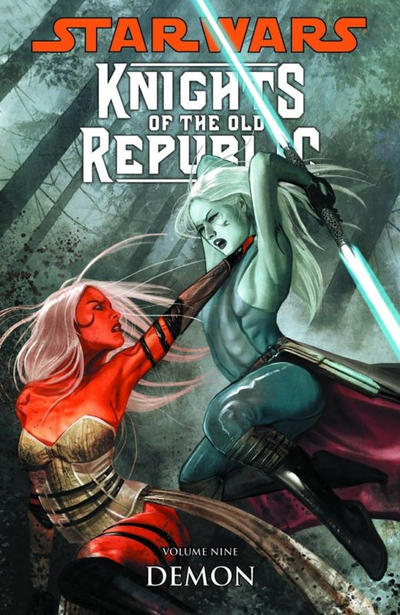
Star Wars: Knights of the Old Republic Vol. 9: Demon
Zayne and his con-artist partner Gryph are finally learning the truth about their fierce friend Jarael and the strange Mandalorian deserter Rohlan. Deception has been company to the foursome since Zayne's life as a fugitive banded them together. Now, as they have continued adventuring across the galaxy, light has shone on each of their pasts. Yet for one of Zayne's companions, a resurfacing past brings deadly peril - and he'll have to call in every favor he can if he hopes to save the day!
More info → |
 |
 |