
“You once saved my people from extinction. Consider our debt now paid.” — Cassus Fett
“Demon” Part 3

Zayne’s quest to save Jarael continues!
Art by Brian Ching
Lettered by Michael Heisler
Colored by Michael Atiyeh
Cover by Benjamin Carré
Edited by Dave Marshall and Freddye Lins
 XWith the next-to-last issue of Knights of the Old Republic, our two tracks of action finally began to converge, with Zayne struggling to discover Jarael’s location and get there in time. Much that’s in the first half of the issue was what I’d had in mind for the Crucible all along; had we targeted a later issue for the final issue, there would have been some elaboration, but essentially everything that appears here would have still happened. A favor is called in that reflects the characters’ understanding of the tensions between Mandalore’s lieutenants, and Golliard gets his come-uppance.
While the writer suggests what goes on each page, the artist is in the driver’s seat when it comes to figuring out pacing. In this case, I’d visualized the space sequence running a page or so longer and the ending combat sequence running shorter; Brian Ching figured out a way to depict the earlier scene more economically, to allow room for more action at the end — as well as something we don’t often do, an interior splash page. It worked out well — especially with Michael Atiyeh’s coloring, which clearly helped us know where we were from panel to panel in the opening. Take another look: the good guys are under blue light, the bad guys under red. Film school secret #427!
This issue resolved a large number of threads that had been out there from the beginning of the series, including the matter of Zayne’s special relationship with the Force. Parenthood showed me something about how children adapt to the physical world. Every child has to learn, one way or another, that physics exists. Things have weight; every action brings an equal and opposite reaction, and so forth. The Force, of course, gives the user the ability to subvert those laws temporarily — though not unnaturally, if we consider the Force as the natural phenomenon it is in the Star Wars universe. So it occurred to me early on that a new Force user would have an additional set of challenges in learning how to affect his or her environment. You’ve got an additional choice in deciding how to move that lamp off the table — but you’ve got to use care, or it’ll tip over just as if you tried awkwardly to pick it up.
Since every action on the physical world is an attempt to increase or decrease the probability of a certain outcome, I saw probabilities as the realm in which Zayne’s learning disability would play out. I suggested in my initial proposal that Zayne existed at, for want of a better term, a right angle to the Force — askew enough, at any rate, that he couldn’t manipulate outcomes as easily as other students. He might reach into the Force to achieve a particular result, but probability would wobble, just like the jostled lamp — or a tipped wine glass. The result would be a successive unlikely result in an undesirable direction — and maybe further positive and negative echoes as the Force sought to establish equilibrium.
We built this into a number of places in the comics, right from the first issue. Zayne would improbably survive a fall through using the Force, but only to land improbably in the presence of his teachers. There was also always a passive element, that his simple presence triggered; when some improbable positive thing naturally happened around him, some improbably negative thing might soon follow, and vice versa. The Jedi Covenant’s negative decision to kill their students, it might be considered, could have had the compensating positive effect of allowing Zayne to luck out and discover Gryph in a crowd right before his graduation ceremony. If he hadn’t, he’d have been on time and would have been killed — and Gryph turned out to be the one person who could keep him alive, anyway.
I don’t want to get to deterministic about it — choices were still made and still have importance — but we can see from it all how Haazen was right: “reversals of fortune” are Zayne’s stock in trade, and not necessarily a hindrance if they can be planned for. Ironically, the two characters who understood Zayne’s abilities best were those who practiced misdirection, as opposed to brute-force direct influence on events: Gryph and Haazen. We do see a bit in Gryph’s speech how someone like Haazen could see value in having Zayne around. We all have the hunch after a bad beat in cards that a big score might come our way. Zayne can count on it!
We tried to reflect a little of this in Zayne’s abilities in the Star Wars Miniature Game, where he had the abilities of Karmic Luck and Karmic Mettle, though they don’t exactly reflect what we saw on the page. It’s tricky anyway, as what we show in game stat blocks has to reflect what the reader knows of the character at the moment; if we weren’t going to fully explain the mechanics until later in the comics, they couldn’t very well be explained in the game.
Another issue we addressed was the origin of Saul Karath. I had seen Saul as disliking both Jedi and Mandalorians because of the attack on the Foerost Shipyards, years ago; we didn’t have room to depict it, but I always assumed that the dockworker that we saw slain in cold blood by Ulic and Mandalore in The Sith War was Karath’s father, Craddock. Golliard had been on station but skedaddled as soon as the ambush began. While it was never a major subplot, we’d provided bits and pieces of this backstory in the Handbook and in the Campaign Guide; it does make Karath’s later service for Malak seem all the more ironic.
Finally, speaking of Malak, we put the final piece into place for the backstory we saw in “Masks.” As mentioned in my earlier notes, some special dispensation must have been given for Revan’s Jedi to go into battle aboard Republic ships when they didn’t have full-throated Council support. What we knew from “Masks” had come from Malak and Ferroh, and as we see here, it was a bit more sugar-coated than the actual situation. The Mercy Corps may not be the most glamourous solution to a historical problem ever, but it does allow all accounts to be true — while showing Revan’s craftiness.
One more issue to go…
“Don’t you get it? For you, the galaxy’s a fair game. Things might look bad — but in the end, everything balances out for you. If you know that, you can use that — my young apprentice.” — Gryph


Veltraa, we may recall, was the ship of Captain Morvis that we saw in #31 and #33, named after the admiral mentioned in “Flashpoint.”
Cassus Fett’s debt to Zayne comes from #28 in “Vector,” of course. Never mind that Zayne had once been sent to assassinate him in #24!
Telettoh, again, is the character based on Pete Hottelet, who won a charity auction to appear in a Star Wars comic book. He was the natural character to appear here, since he was privy to everything that had happened in “Masks.” While we do see Carth back on the bridge again, evidently having worked off the demerits that got him kicked off the bridge in #31, he didn’t have the information Telettoh had to impart.
Rohlan’s words in Mando’a to Cassus translate to “a Mandalorian never forgets,” or words to that effect.
Intentional Allusion Department, Part the First: Golliard’s reference to Force visions and strokes hearkens back to Krynda’s unhappy episode.
Not saying whether it’s intentional or not, but Demagol’s got a real Red Sith face-tentacle thing going with that moustache!
Intentional Allusion Department, Part the Second: Gryph’s two big “moment of truth” speeches during the series involve spilled goblets.
That whip of Chantique’s is pretty animated — but looking at how Chantique throws those spears with the Force, Making Whips Look Cool is likely a simple matter!
Intentional Allusion Department, Part Enough Already: Setting Jarael and Chantique’s showdown in what is, effectively, a schoolroom, bring us back to where the series began.
Ticking down to the final issue, it’s time to reveal, finally, whose voice I sometimes “hear” when writing dialogue for Zayne: I often think of Eric Stoltz in the John Hughes Some Kind of Wonderful era. He bears more than a passing resemblance to Zayne in that picture, and his character has a similar boyish everyman quality.

Latest Edition

Star Wars: Legends Epic Collection – The Old Republic Vol. 3
Zayne Carrick's adventures continue in the finale to the Knights of the Old Republic comics series! Contains issues #37-50 of the Knights of the Old Republic comics series and issues #1-5 of the Knights of the old Republic: War series.
More info →



Earlier editions

Star Wars Omnibus: Knights of the Old Republic Vol. 3
Free at last from the false charges against him, former Padawan Zayne Carrick is ready and able to search out adventure with his group of companions, but when he discovers that one of his allies, the beautiful Jarael, has been running from her past, he dedicates himself to her redemption. Soon, Zayne is caught in a web of sport dueling, slavery, an evil twin, an ancient society, and finally, the frontline of the Mandalorian Wars!
More info →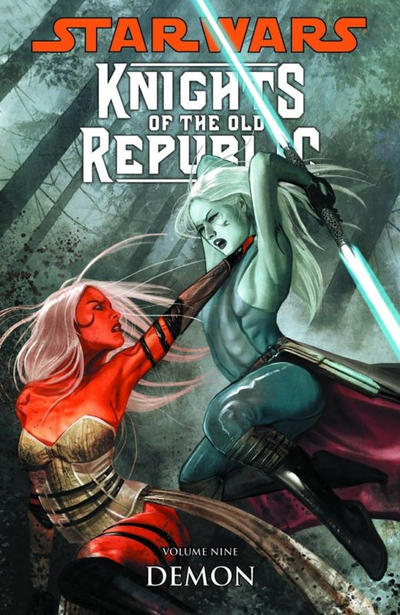
Star Wars: Knights of the Old Republic Vol. 9: Demon
Zayne and his con-artist partner Gryph are finally learning the truth about their fierce friend Jarael and the strange Mandalorian deserter Rohlan. Deception has been company to the foursome since Zayne's life as a fugitive banded them together. Now, as they have continued adventuring across the galaxy, light has shone on each of their pasts. Yet for one of Zayne's companions, a resurfacing past brings deadly peril - and he'll have to call in every favor he can if he hopes to save the day!
More info → |
 |
 |