
“Everything balances out.” — Zayne Carrick
“Demon” Part 4

The colossal conclusion!
Art by Brian Ching
Lettered by Michael Heisler
Colored by Michael Atiyeh
Cover by Benjamin Carré
Edited by Dave Marshall and Freddye Lins
 When I moved into the dormitory as a college undergraduate, I didn’t expect to live there long. It was an all-freshmen floor, and it was chaotic and crowded and I couldn’t focus on anything. That all changed when I learned that the huge “study room” at the end of the hall was once a dorm room — and all I had to do to commandeer it for myself was request it. So the freshmen lost their rumpus room — and I gained the biggest room in the dorm.
For the next several years, it became something of a haven for those rare students who could pass a sobriety test: I had friends stopping by to read my comic books and study the wargames we had tacked to the wall. It also became my own private studio, as I cranked out minicomics and fanzine articles — and developed the beginnings of a solid science fiction universe with a future novel in mind. I wound up staying on that freshman floor all four years, straight through to graduation.
That novel stalled out soon after I left the dorm, as did many of my other projects. But I still remember the time as a highly creative one — one in which I began to really think about story characters in relation to their surroundings and each other. And while Knights of the Old Republic (the product of another four years) bears no resemblance whatsoever to that stillborn SF-world, I do recognize the feeling I got working on the series. It wasn’t so much world-building, because the world was already built. It was more along the lines of, “OK, we’re here. Everyone out of the car — let’s see what kind of trouble we can find!”
Trouble found Zayne Carrick in the beginning, and that became the story for much of the series. The concept for the post-“Vindication” arc always was that he would look for trouble — by looking into the troubles that plagued Jarael from the start. This issue, the resolution of “Demon,” brings that storyline to an end, and if it’s not exactly as I might have done it with a couple more issues to spare, it’s also not how I would have done it had we wrapped in, say, #48, either. Monthlies aren’t quite the same as mini-series or graphic novels. “The End” tends to be a moving target. But the big things I always intended to happen, happened.
Demagol and Chantique here close the circle of feeling and unfeeling begun, somewhat subtly, with Goethar and Aubin Kleej. Demagol, as an empathetic Zeltron, is stunted by growing up amid emotionless Iskalloni; Chantique feels everything, a terrible thing to do when you grow up surrounded by pain and anguish. Chantique was already on a bad path before the Crucible arrived, as we saw; what little we know of her mother suggests she was troubled — and it’s not hard to imagine Demagol’s parental indifference starting far earlier. (“Prenatal” indifference?) Chantique wasn’t the experiment that worked.
But then, there were no experiments that did work — a message I didn’t mind conveying. “You can’t grow Jedi,” Zayne says, and at least in this case, he was right. That said, I wasn’t always sure I’d go for the twist we saw here; that’s why every scene about Jarael’s capabilities played both ways. There weren’t many, but they were all crafted so that she might believe she’d done something using the Force — and that her belief would inform the reader. But there were always alternative explanations for everything. As time went on, the twist — deceiving the deceiver — seemed so poetically just there wasn’t a case to play it any other way.
Rohlan gets the ending I always imagined. I long said that we’d try to answer every question raised by the series, and I think we did. But the questions about the Mandalorian Wars that Rohlan was investigating were raised outside this series, in the games — and wherever the answers lie, Rohlan Dyre did not find them in 3963 B.B.Y. It is the cost of turning one’s back on a target that’s still breathing. Still, he gets closure with regard to Demagol, with the symbolic stripping away of armor; without this act, the final blow may not strike home.
Still, of everyone, Rohlan would appear to have the most active future immediately ahead of him. Demagol is still believed to be at large, which is why Rohlan needs to melt away. The one outing to the apartment complex was his only public appearance in that guise; presumably, anywhere he goes, he’ll look like someone else. (Or Spikes — as we note, he still has the case.) And while he may certainly “remain dead” as he promised in the sense that he won’t upset Cassus’ story of Rohlan the Questioner, he said nothing about leaving his quest for answers. Now, it might be even easier.
So we begin and end with a fugitive — but given what we know about the era, the Republic is soon to have much bigger things to worry about.
We also got some moments with the rest of the cast. Elbee had his big moment a few issues earlier, and we see him here as a greeter. (Or, as another unmoving statue. He’s good at that.) Slyssk, probably the most gentle character I’ve ever written, gets to appear in his element.
Gryph is pretty hard to leave behind. I never thought the series had any kind of a character representing the author’s viewpoint, in that Gryph was frequently wrong, and wrong-headed, about what was going on — but he had a philosophical purity that made him an absolute joy to write. At times, we asked ourselves if Gryph didn’t need to grow somehow during the series. But when I thought about it, the answer always was that he was growing — growing more and more convinced his worldview was correct with every single episode they faced. Even failing to leave Serroco was a rational exercise in profit and risk — and as we saw, the correct financial decision was to stay!
That makes him a fanatic — but reasonably harmless, as fanatics go. As some people get older, they don’t change as much as they become more and more extreme versions of themselves. Given that, I’m not sure Old Gryph is someone you want to rent from!
Finally, Zayne and Jarael — and the relationship. The thinking was never that Zayne wasn’t interested in Jarael; rather, he never would have thought it possible, given who he was and who she was. Even before we knew her exact age, I’d realized that Zayne was too young for Jarael. She’d endured much more hardship in her life, while he’d gone through a bad few months at most. He just didn’t have the presence of a Malak, as that rival would later imply. They weren’t equals. But neither could she hope to connect with Malak or anyone else while trust and her past remained such issues for her.
 The post-“Vindication” issues tackled the matter head-on. When Zayne’s youth and seriousness becomes an issue, he declares his intent to prove otherwise. He’s tested. He fails. And he tries again. And while he’s not trying to prove himself to her to win her heart (Jarael would object to being anyone’s “prize” just as Shel did), he does win her trust. His “anniversary gift” to her, restoring her family, is beyond her wildest imaginings — but the apology beforehand is probably just as important. The “every day’s a compromise” speech couldn’t have been uttered by Zayne in #1. He wasn’t there yet.
So what we see at the end is that they’ve decided to consider their feelings for each other — now that they can do it as equals. We don’t know if we’re seeing something that will last, or not — but then, that’s true for everyone in the series. Certainly, great hardships remain not too far away in continuity for the people of the Republic. We may see them again; we may not. But Zayne’s year on the run ends here, and better than it began.
So, too, with Knight Errant around the corner, Knights of the Old Republic comes to a close for me as well. It was a wonderful journey, taken along with some talented fellow creators into some strange and unexpected places — and one I’ll remember for a long time. A journey that, in some small way, began for me many years ago at the University of Tennessee.
In Room 943, North Carrick Hall.
“Mastermind!” — Gryph


Well, I’ve already burned the best trivial bit in the previous paragraph. Amazingly, no one picked up on it — except for Campaign Guide editor Rodney Thompson, a fellow Tennessee alum, and only after I mentioned it. In truth, I’d looked at “carrack” (a merchant ship) and “carrock” (a Tolkien location), but wasn’t sure everyone would pronounce them the same. “Zayne” was simply a western-sounding name, with a little Star Wars pizzazz.
Tricks of the Trade Dept.: There were a lot of things going on in this issue — and when that happens, I sometimes turn to a very low-tech solution: my magnetic storyboard. Here’s the one for this issue:

The colored magnets, crafted by my son, remind me which pages are facing pages and allow me to move around cards saying which page is which. As you can see, I don’t bother to spell (“fite”) — and I recycle the cards from issue to issue (I’m an environmental comics writer). There’s even some old cards from Mass Effect: Redemption #1 and a plot card from Dawn of Defiance in here. I don’t do these for all issues — just the ones where I want to look at the pages and where the breaks are. Every page should have one basic idea, as Randy Stradley says — and I always try to look at how facing pages work together, and how left-hand pages can be used to create reveals.
Just one of the tools I sometimes use — and probably the most visual, despite its comically low-tech nature. Sure, I could get a copy of Final Draft or something to do the same thing, but I stare enough at the computer screen as it is…
Speaking of layout, this was one of those issues where ad placement really helped, as the ad drops made for some additional “reveals.” They won’t be in the trade, obviously, but they’re nice effects in the comics.
Zayne and Rohlan are dropped from mid-air by the Testament, which was too big to land in this wooded zone.
While not the exact same sound effect that we depicted in Jarael’s previous skylight crashes, Zayne’s impact is spelled just the same.
“Dar’manda,” as Rohlan yells, is pretty much the worst thing a Mandalorian can call another, and means about what Rohlan says.
That’s Demagol’s breast-plate that Rohlan is ripping off in the fight scene. It’s why Demagol’s chest is unprotected in later scenes.
Chantique’s stab in the back isn’t immediately fatal; recall she used her healing powers to survive a similar wound, issues ago. My presumption was the proximity of Kun’s saber kept her mobile long enough for her final act.
It is true that the Campaign Guide lists Jarael as “Strong in the Force” — a reflection of the drive in descriptive works to reflect what we know about the character at the time. I didn’t know for sure when the Guide would be released relative to “Prophet Motive,” but figured that leaving it out would cause more immediate questions. And as Zayne says, she may have some connection somehow, sometime — she’s just not the Force savant that Demagol imagined.
Brian was careful to establish the location of the two lightsabers on the ground such that both would be available to Demagol. Being his first time at levitation — and a split-second impulse at that, my expectation is that he had no knowledge of what lightsaber he finally held. The entire page takes less than a second.
The parents are a point we planted several issues earlier, and we see them both before and after the Crucible raid in #48. As his past meeting with them implies, one of Rohlan’s runs thus must have taken him to Coruscant.
Goodvalor’s Little Bivoli, we can see more clearly in this issue, is an actual replica of the Little Bivoli seen in “Days of Fear.” It’s not a ship, but a physical building — and not a mess hall, but a posh eatery with the same architecture. It’s amazing how a few potted plants can make the same place look different! And as Gryph tells us in #47, it’s a franchise, so there may well be other Little Bivolis here and there…
That does appear to be a Santa in the restaurant sequence populated by Brian Ching; the issue was completed right around the holidays. I don’t believe that’s supposed to be Revan, at the end — he would have had other things to do.
This issue’s letter column referred to a working title for “Knight Errant,” “Jedi.” The title changed to the final one shortly after the issue went to press. There had already been some “Jedi” issues at Dark Horse, and “Knight Errant” was my original working title on the first pitch.
The last words, “Another Beginning,” of the last page of the story echoed those on the last page of “Commencement.” For a time, I’d considered “Valediction” for the title of this storyline, given our earlier school-like titles, and the “Vector, Vindication, Valediction” alliteration. But “Demon” fit much better. And as Demagol’s name contracted “demon” with the real star Algol — which I later learned was known as the “demon star,” it was hard to find a better name!
Speaking of Demagol, the next story in continuity — preceding War — is “The Secret Journal of Doctor Demagol.”

Latest Edition

Star Wars: Legends Epic Collection – The Old Republic Vol. 3
Zayne Carrick's adventures continue in the finale to the Knights of the Old Republic comics series! Contains issues #37-50 of the Knights of the Old Republic comics series and issues #1-5 of the Knights of the old Republic: War series.
More info →



Earlier editions

Star Wars Omnibus: Knights of the Old Republic Vol. 3
Free at last from the false charges against him, former Padawan Zayne Carrick is ready and able to search out adventure with his group of companions, but when he discovers that one of his allies, the beautiful Jarael, has been running from her past, he dedicates himself to her redemption. Soon, Zayne is caught in a web of sport dueling, slavery, an evil twin, an ancient society, and finally, the frontline of the Mandalorian Wars!
More info →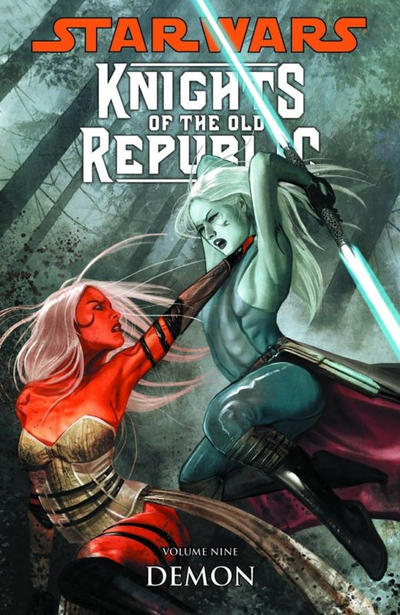
Star Wars: Knights of the Old Republic Vol. 9: Demon
Zayne and his con-artist partner Gryph are finally learning the truth about their fierce friend Jarael and the strange Mandalorian deserter Rohlan. Deception has been company to the foursome since Zayne's life as a fugitive banded them together. Now, as they have continued adventuring across the galaxy, light has shone on each of their pasts. Yet for one of Zayne's companions, a resurfacing past brings deadly peril - and he'll have to call in every favor he can if he hopes to save the day!
More info → |
 |
 |