

“I’ve been condemned. I’m a slave.” — Ori Kitai
Star Wars: Lost Tribe of the Sith Part 5: Purgatory

My fifth Star Wars eBook for Del Rey, in which we learn one of the humans on Kesh is not what he seems to be…
Cover by Dave Stevenson
Edited by Shelly Shapiro
 I had once joked that I wanted to write a “Sith Harlequin romance,” and while the Purgatory/Sentinel pairing is not exactly that, it does begin with a beautiful noblewoman flirting with a burly farmhand — even imagining him with his shirt off, at one point. That it was actually an important moment in the history of the Lost Tribe, with a connection to the Knights of the Old Republic series, made it all the more fun. It was exactly the kind of story I wanted to follow up the Korsin/Adari/Seelah arc with.
The time jump after Savior was the longest by far, more than a thousand years. It was necessitated in part by the KOTOR connection I was introducing — but I would have advanced the story a millennium or so in any event, to show that things had run more or less business-as-usual for the Sith for a long time, with political intrigue a fact of life and with some early ideas surviving to become full-fledged institutions.
The notion that humans on Kesh could become enslaved came from the original background document that Aaron Allston, Christie Golden, and Troy Denning provided for the Tribe. It wasn’t in play back in the earliest days of the first stories, but it’s clearly been around for most of the time that humans have been on the planet. Human genes would have been in precious enough supply on Kesh that the Tribe wouldn’t have wanted to cull its dissidents too often; there needed to be a punishment short of death. And human slaves would create a new class for the Sith to mistreat, which is something they love to do.
We also get to see the High Lord/Grand Lord political system (also established by the three Fate of the Jedi authors) in action. The story doesn’t spend any time on what the Red and Gold factions actually believe. This is intentional. While that would have been difficult to develop given episodes running only 8,000 words, the larger point is that after so many years of intramural shenanigans, they don’t believe anything, other than “us” versus “them.” Oceania has always been at war with Eurasia. Or is it Eastasia? It doesn’t much matter!
The Jelph connection was something I did not undertake lightly. I had no interest in cross-fertilizing the different series for its own sake, and while it’s suggested there may be reasons why Kesh attracts crash-landings, I couldn’t let anything happen that would alter the situation seen at the start of the Fate of the Jedi novels. But I knew I wanted to get a Jedi’s view of Sith society, and making him part of an organization obsessed with watching for the Sith amped up the conflict in his life tenfold. The Covenant Shadows were already off the grid and one wouldn’t be missed — and the timing of his flight, after the events of Vindication, meant that he and Ori would share the same desire for recovering their past status.
Where water had been a thematic element in Paragon, Purgatory/Sentinel had a much earthier one in soil (and a smellier one in manure). There’s an old joke about a kid digging through a mount of manure happily because there just has to be a pony in there someplace; indeed, we can imagine Jelph is speaking with a wink when he refers to his life being under the dirt. “I may not be of the Tribe, but at least I’ve got a ship!”
“How does a farmer know about these things?” — Ori Kitai


In Pantheon, we are told that Nida Korsin ruled 79 years, so her reign went from 4975 to about 4896. Donellan, born in 4960, would have died not long before she did.
The references to the haunted Ragnos Lakes area are a holdover from the events of Paragon. Remember, the Keshiri were given a cover story for what happened there, and not all the Sith would have known otherwise.
We’d established that the peaks of the Takara Mountains could be seen from Tahv; while there’s a great distance between them, my expectation is that the air is incredibly clear on Kesh, except during periods of volcanic activity. Tahv would also be on a slope leading up to the highlands itself, taking advantage of that in its aqueducts. The city is called the “High Seat” in several places; it’s likely not just because of who lives there.
The arena scene with its royal boxes is probably our one sequence most out of the Roman Empire.
Jelph thinking about the chemistry of fertilizer is one of those moments that should have been the first clue for readers that he’s not what he appears. We don’t see a lot of chemistry being taught in the Tribe.
With the shovel we get another reminder of how poor Kesh is in metals, something established in Skyborn. It’s part of the reason (but not the only reason) that the Sith didn’t simply reenact an industrial revolution on Kesh.
Jelph Marrian is named in Vector, when Lucien names the agents who were working on the Outer Rim in Knights of the Old Republic #27. I suppose he could be the blond human immediately to Celeste’s left in the computer shot in #25, but that would have to be a much younger depiction of him.
The Aurek-class Tactical Strikefighter, which I drew from the KOTOR video game, comics, and RPG guide, has a tiny nod to the comics series in its name. It’s from production run 35-C, which is a reference to the 35th issue of KOTOR and the breaking of the Covenant. That’s the moment that Jelph would have fled for Kesh.
The original eBook included a preview of Troy Denning‘s novel, Fate of the Jedi: Vortex.

Latest edition
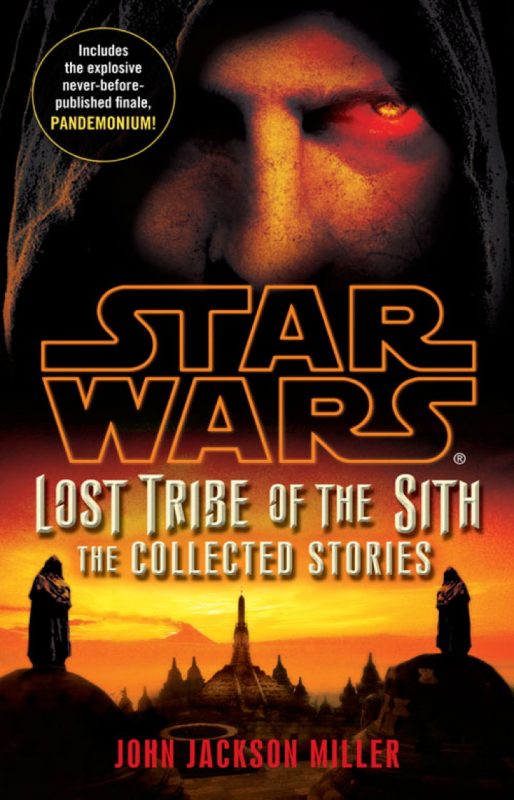
Star Wars: Lost Tribe of the Sith – The Collected Stories
Five thousand years ago. After a Jedi ambush, the Sith mining ship Omen lies wrecked on a remote, unknown planet. Its commander, Yaru Korsin, battles the bloodshed of a mutinous faction led by his own brother. Marooned and facing death, the Sith crew have no choice but to venture into their desolate surroundings. They face any number of brutal challenges—vicious predators, lethal plagues, tribal people who worship vengeful gods—and like true Sith warriors, counter them with the dark side of the Force.
The struggles are just beginning for the proud, uncompromising Sith, driven as they are to rule at all costs. They will vanquish the primitive natives, and they will find their way back to their true destiny as rulers of the galaxy. But as their legacy grows over thousands of years, the Sith ultimately find themselves tested by the most dangerous threat of all: the enemy within.
More info →


 |
 |
 |